
The Story
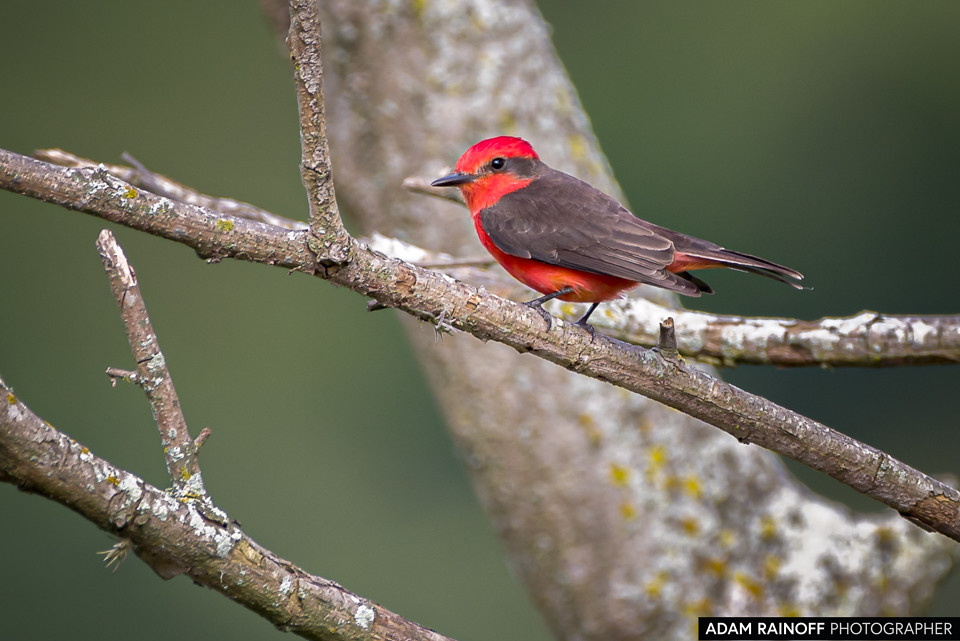
I photographed this Vermilion Flycatcher (Pyrocephalus rubinus) at Reserva Natural Agua Fría in Ibagué, Tolima, Colombia. It catches insects in flight. Females build a shallow open cup nest and incubate the eggs, and the male feeds the female during incubation. Both parents feed the chicks, which are ready to fledge after about 15 days. Its song is variable and plays an important part in holding a territory. It stands out among the mostly drab tyrant flycatchers for its vermilion-red color. Males have bright red crowns, chests and underparts with brownish wings and tails, while females lack the vivid red. Agua Fría is one of the civil-society reserves of Ibagué’s nature tourism network, in premontane humid forest at about 1,150 to 1,200 meters.
I made this frame with a Pentax K-1 and the HD Pentax-D FA 150-450mm f/4.5-5.6, at 1/250 sec, f/5.6, ISO 400, +0.7 EV. IUCN lists the Vermilion Flycatcher as Least Concern, with an increasing population.
©2019 Adam Rainoff Photographer
The bird
The Vermilion Flycatcher (Pyrocephalus rubinus) belongs to the family Tyrannidae (Tyrant Flycatchers) in the eBird/Clements taxonomy.
Source: eBird.org (opens in a new tab)
Conservation
Least Concern on the IUCN Red List (assessment published 2021), with the population trend listed as increasing. Source: IUCN Red List