
The Story
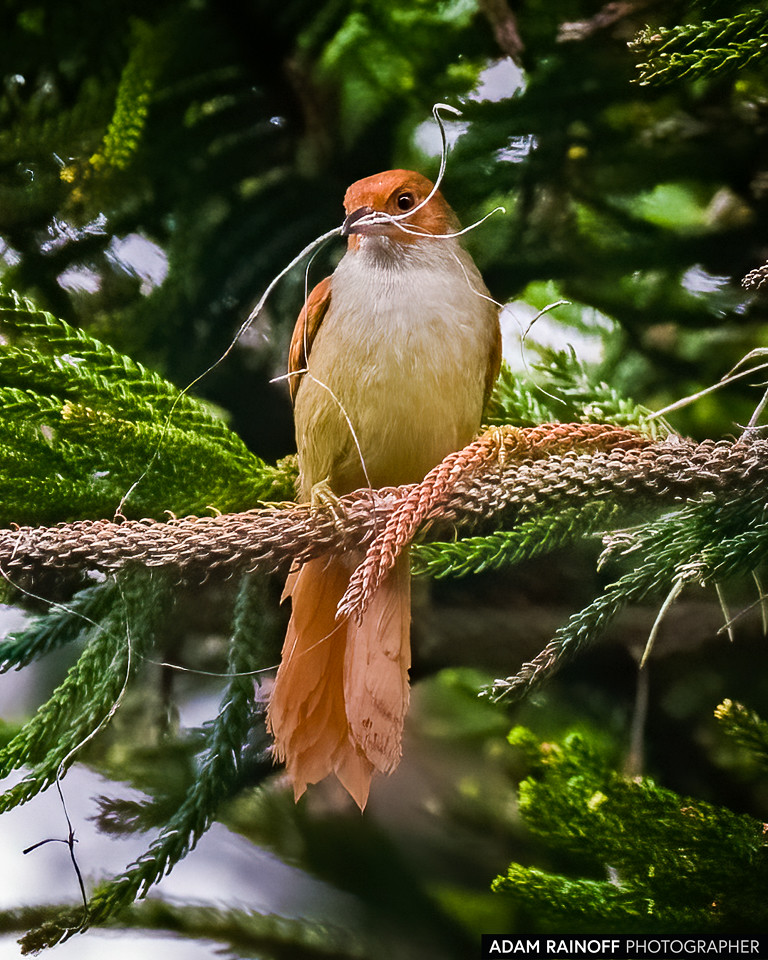
This Red-faced Spinetail (Cranioleuca erythrops) was at Hacienda Guadalajara in Palmira, Valle del Cauca, Colombia when I photographed it. It lives mostly in lower to mid-elevation montane forest, including mature secondary forest. It forages alone or in pairs, usually as part of a mixed-species flock. Its nest is a ball of moss and vine stems with an entrance at the bottom. Loose bits of material dangle above and below the nest so that it looks like random debris. Palmira lies on the east bank of the Cauca River and is a center of the valley’s large sugar mills.
I made this frame with a Pentax K-1 and the HD Pentax-D FA 150-450mm f/4.5-5.6, at 1/2500 sec, f/5.6, ISO 6400. IUCN lists the Red-faced Spinetail as Least Concern, with a decreasing population.
©2020 Adam Rainoff Photographer
The bird
The Red-faced Spinetail (Cranioleuca erythrops) belongs to the family Furnariidae (Ovenbirds and Woodcreepers) in the eBird/Clements taxonomy.
Source: eBird.org (opens in a new tab)
Conservation
Least Concern on the IUCN Red List (assessment published 2020), with the population trend listed as decreasing. Source: IUCN Red List