
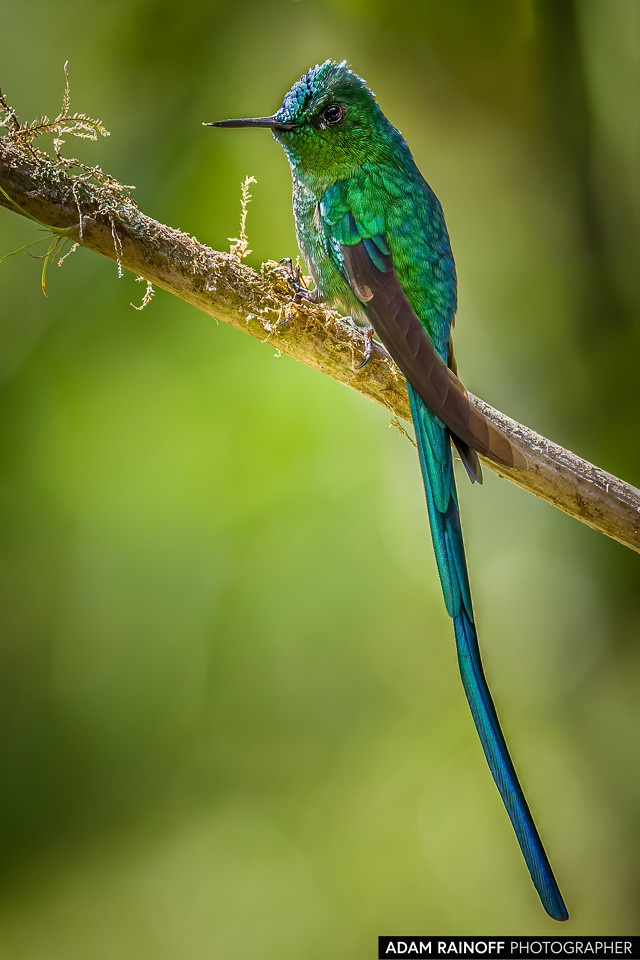
The Story
I photographed this Long-tailed Sylph (Aglaiocercus kingii) at La Florida, El Bosque de las Aves, in the Kilómetro 18 area near Cali, Valle del Cauca, Colombia, in October 2019. Males carry outer tail feathers about 12 centimeters long, while females have a short, somewhat forked tail. Females have a white throat speckled with green and cinnamon underparts. It feeds on nectar by trap-lining or defending territories, and it sometimes steals nectar by piercing the base of a flower. Andean populations move seasonally between lower and higher elevations. IUCN lists it as Least Concern, though its numbers are believed to be falling.
I used a Pentax K-1 with the HD Pentax-D FA 150-450mm f/4.5-5.6 for this one, at 1/800 sec, f/7.1, ISO 400, −0.7 EV. It is common in much of its range, but clearing habitat for cattle in Colombia and Ecuador is a potential threat.
©2020 Adam Rainoff Photographer
The bird
The Long-tailed Sylph (Aglaiocercus kingii) belongs to the family Trochilidae (Hummingbirds) in the eBird/Clements taxonomy.
Source: eBird.org (opens in a new tab)
Conservation
Least Concern on the IUCN Red List (assessment published 2024), with the population trend listed as decreasing. Source: IUCN Red List