
The Story
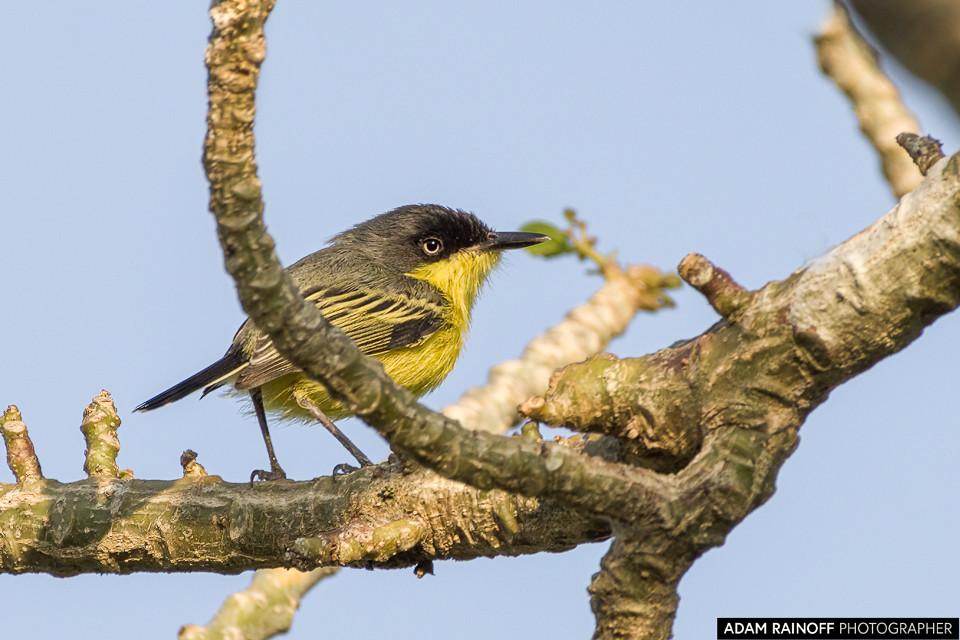
I made this photo of a Common Tody-Flycatcher (Todirostrum cinereum) at Reserva Natural La Palmita in Trinidad, Casanare, Colombia. The Common Tody-Flycatcher forages very actively, hopping sideways along branches with its tail cocked and wagging. It is believed to be a year-round resident. It usually forages in pairs or small family groups in dense vegetation near the ground. It takes prey from foliage by gleaning and with short sallies from a perch. La Palmita’s research center has recorded 250 bird species and 39 bat species in the flooded savannas of Trinidad. IUCN lists the Common Tody-Flycatcher as Least Concern, with a stable population.
I used a Pentax K-1 with the HD Pentax-D FA 150-450mm f/4.5-5.6 for this one, at 1/400 sec, f/5.6, ISO 100. La Palmita conserves its flooded savannas through its cattle ranching and has welcomed visitors since 2013, so every stay supports sustainable tourism in the region.
©2019 Adam Rainoff Photographer
The bird
The Common Tody-Flycatcher (Todirostrum cinereum) belongs to the family Tyrannidae (Tyrant Flycatchers) in the eBird/Clements taxonomy.
Source: eBird.org (opens in a new tab)
Conservation
Least Concern on the IUCN Red List (assessment published 2021), with the population trend listed as stable. Source: IUCN Red List